The Intelligence Layer: Why Traditional Scaling Can Shrink Profits
Discover how ERP, BI, automation and AI can reduce manual work, connect business processes and help organizations scale with better decision-making.
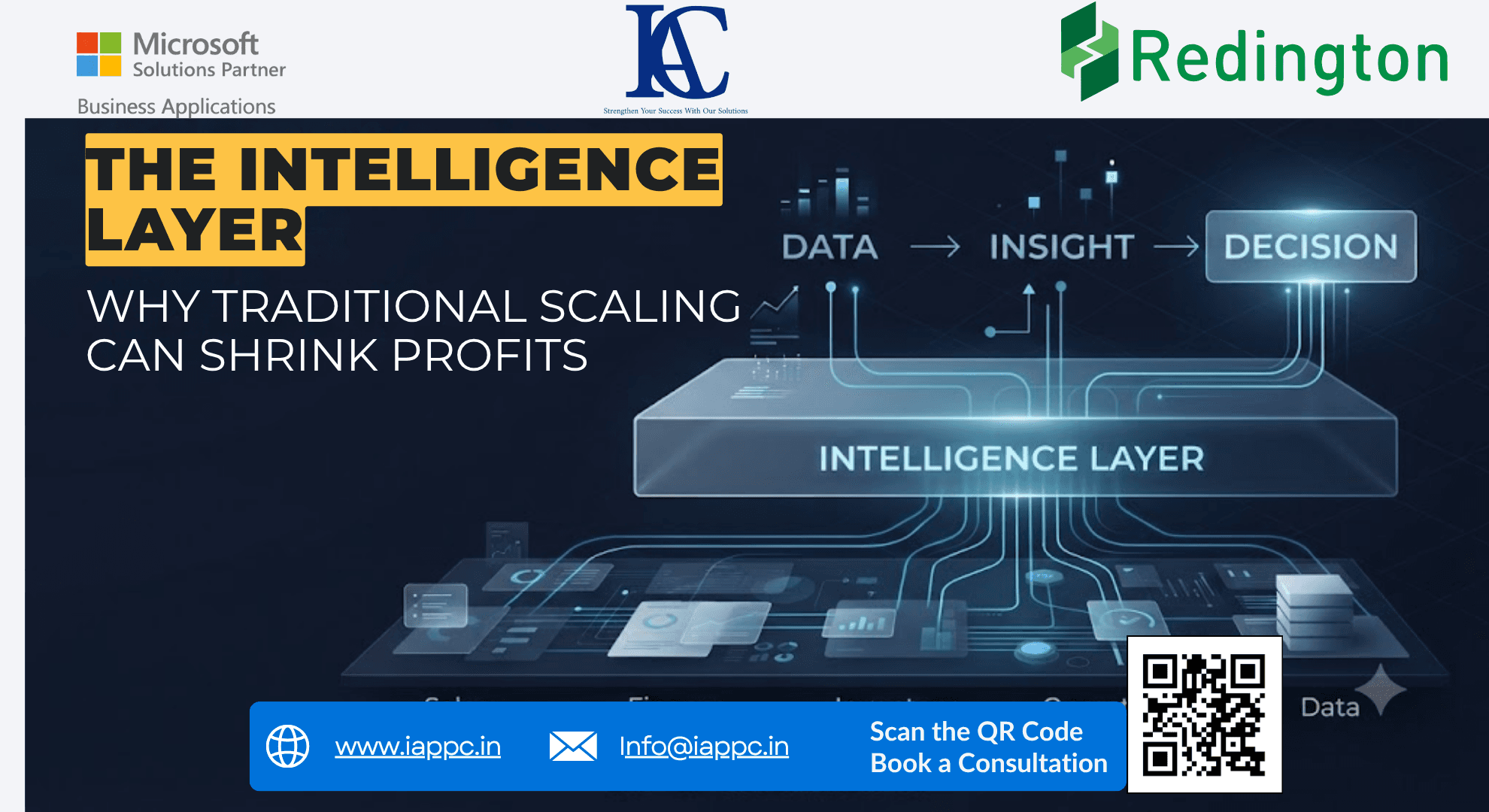
Growth creates a problem that most businesses do not notice early enough.
Orders increase. Teams grow. Data multiplies. More customers enter the pipeline. Finance receives more transactions, operations manages more exceptions, and management asks for more reports.
Yet the business does not necessarily become more profitable.
In many organizations, growth simply increases the amount of manual coordination required to keep the business running.
A sales order is entered in one system. Inventory is checked in another. Finance reconciles an Excel file. A manager asks for a report. Someone exports data, cleans it, combines it and finally sends an answer.
The business has software.
But the software is not necessarily helping the business think.
That is where the idea of an intelligence layer becomes important.
An intelligence layer connects transactions, processes, data and decision-making so that technology does more than record what happened. It helps people understand what is happening and act on it.
1. Scaling the Old Process Only Scales the Problem
Imagine a manufacturing company processing 500 orders a month.
A few spreadsheets may be manageable.
Now increase that to 5,000 orders.
The underlying process has not changed. The organization has simply multiplied the number of transactions moving through it.
The same problem appears across industries:
The issue is not that employees are inefficient.
The issue is that the process depends on employees repeatedly connecting systems and information manually.
That creates what can be called a digital duplication tax.
The same information is entered, exported, cleaned, checked and reconciled multiple times.
The cost is not visible as a separate invoice.
It appears as employee hours, delayed decisions, reporting effort, rework and management attention.
2. The Real ERP Question Is Not “What Does It Cost?”
ERP discussions often begin with software licensing and implementation cost.
A better starting point is:
How much unnecessary work exists because the business does not have one connected operational system?
Consider a finance team that spends two days every month consolidating sales, inventory and receivables data before management can review performance.
The spreadsheet itself may cost almost nothing.
The process does not.
Microsoft Dynamics 365 Business Central is designed to connect core business processes across areas such as finance, sales, purchasing, inventory and supply chain operations. Microsoft also continues to add Copilot and agent capabilities that work with Business Central data and workflows.
This changes the ERP conversation.
The objective is not simply to replace Excel.
It is to reduce the number of manual handoffs required to move from:
Transaction → Data → Analysis → Decision
to:
Transaction → Connected Data → Intelligence → Decision
3. The Dashboard Is Not the Destination
For years, business intelligence has largely meant dashboards.
Dashboards remain useful, but the executive problem has changed.
A CFO does not necessarily want another dashboard.
The CFO may simply want to ask:
Which products generated the highest gross margin last month?
Or:
Which customers have increasing receivable exposure?
Or:
Where are inventory levels growing faster than sales?
The value lies in reducing the distance between the question and the answer.
Microsoft Business Central now includes capabilities such as Chat with Copilot and Analysis Assist. Users can use natural-language requests to find business data and organize records into analysis views. Microsoft specifically describes Analysis Assist as a way to structure and display data for analysis rather than automatically making the business decision for the user.
That distinction matters.
AI does not replace executive judgment.
It can reduce the technical friction involved in reaching the information required for that judgment.
IAPPC's BI Reporting offering follows a similar principle at the application level: users can work with Excel, CSV, API or system-generated data and describe the type of analysis, comparison or visualization they want.
The broader principle is simple:
Technology should reduce the distance between business questions and business data.
4. ERP Is a Business Transformation Project, Not Just an IT Project
One of the most important ERP decisions happens before configuration begins.
It is deciding whether the implementation will be treated as a software installation or a business-process transformation.
For a manufacturing organization, an ERP system has to understand the relationship between:
Procurement → Inventory → BOM → Production → WIP → Finished Goods → Sales → Finance
For a distributor, the critical flow may be:
Purchase → Receipt → Inventory → Sales Order → Picking → Dispatch → Receivables
For a professional-services company:
Lead → Proposal → Project → Resource → Timesheet → Billing → Profitability
The technology should reflect these operational relationships.
If the process is poorly understood, even a capable ERP can reproduce the organization's existing problems in a more sophisticated interface.
This is why implementation should begin with questions such as:
Where does information originate?
Who changes it?
Where is it duplicated?
Which decisions depend on it?
Where does approval slow down the process?
Which reports require manual consolidation?
Which exceptions repeatedly require management intervention?
Only then should the conversation move toward configuration, integrations, automation or AI.
5. AI Is Moving Work, Not Simply Removing It
The more useful question about AI is not:
“Which jobs will AI eliminate?”
It is:
“Which parts of a job should no longer require human attention?”
Microsoft's 2026 India Work Trend Index findings describe a growing group of workers redesigning workflows around AI agents, while also emphasizing the continued importance of human judgment and critical thinking.
The operational implication is significant.
A finance employee may still own the financial decision while AI helps organize transactions.
A recruiter may still make the hiring decision while AI handles high-volume initial screening.
A sales manager may still own the customer relationship while software captures and structures lead information automatically.
That is the unbundling of work.
For example, IAPPC's Talent Synth describes AI-based resume screening and 24/7 automated interviews, while its Biz Analyzer can extract business-card information and move captured contacts into a lead-management workflow.
There is also independent evidence that candidates can accept AI-mediated hiring experiences. A large field experiment involving more than 70,000 applicants found that 78% of candidates who were given a choice selected an AI voice interviewer. That result should be interpreted as evidence about that experiment's population and context—not as proof that candidates universally prefer AI hiring.
The lesson for businesses is broader than recruitment.
Automate the repetitive layer. Keep human ownership where judgment matters.
6. The Intelligence Layer Connects the Pieces
This is where ERP, BI, automation and AI start to become part of the same architecture.
Consider a growing distributor.
The ERP records sales orders, inventory, purchasing and receivables.
Automation moves information between processes.
BI turns operational data into analysis.
AI helps users interact with information, identify patterns or execute defined tasks.
The architecture becomes:
ERP Foundation
↓
Connected Operational Data
↓
Automation Layer
↓
AI / Intelligence Layer
↓
Human Decision
This is more useful than adding isolated software tools whenever a new problem appears.
The goal is not to make every process “AI-powered.”
The goal is to determine where intelligence actually reduces friction.
7. The Enterprise Example: From 20 People to 200
Consider a software-services business growing from 20 employees to 200.
At 20 people, project managers may manage resource allocation in spreadsheets. Finance may reconcile invoices manually. Managers may ask individual employees for project-status updates.
At 200 people, the same approach becomes difficult to sustain.
The company does not necessarily need ten times more coordination.
It needs better process architecture.
A connected system can bring together:
Customer and project information
Resource allocation
Timesheets
Expenses
Billing
Receivables
Project profitability
Management reporting
AI can then sit on top of this operational foundation.
That sequence matters.
AI cannot compensate for disconnected business processes indefinitely.
The intelligence layer becomes valuable when the underlying data and workflows are structured well enough to support it.
8. The Question Leaders Should Ask
The next stage of digital transformation is not about collecting more applications.
It is about reducing the distance between an event and a decision.
When an order arrives, how long before management can see its financial and inventory impact?
When a customer payment is delayed, how quickly can finance identify the exposure?
When inventory moves unexpectedly, how quickly can operations understand why?
When a new lead enters the business, how much manual work occurs before it becomes actionable?
These are not purely technology questions.
They are business-process questions supported by technology.
That is the real purpose of an intelligence layer.
Conclusion: Scale the Intelligence, Not the Manual Work
Traditional scaling says:
More business → More people → More spreadsheets → More coordination
Intelligent scaling aims for:
More business → Connected processes → Better data → Automation → Faster decisions
ERP provides the operational foundation.
BI makes business data easier to analyze.
Automation removes repetitive handoffs.
AI can make information and execution more accessible.
But none of these technologies should be implemented simply because they are available.
The better question is:
Where does your business lose the most time between an event and a decision?
That is often where the intelligence layer should begin.
At IAPPC, the practical objective is not to add technology for its own sake. It is to understand the business process first, connect the right systems, automate repetitive work and create a stronger foundation for intelligent decision-making.
Because sustainable growth is not just about doing more.
It is about making the business capable of handling more without multiplying the work required to understand it.