Small Language Models in Enterprise Agentic AI: Why Smaller Models Can Deliver Higher Production ROI
Small language models can cut costs and latency on narrow enterprise tasks. See the hybrid SLM-LLM architecture, private deployment options, and a rollout plan.
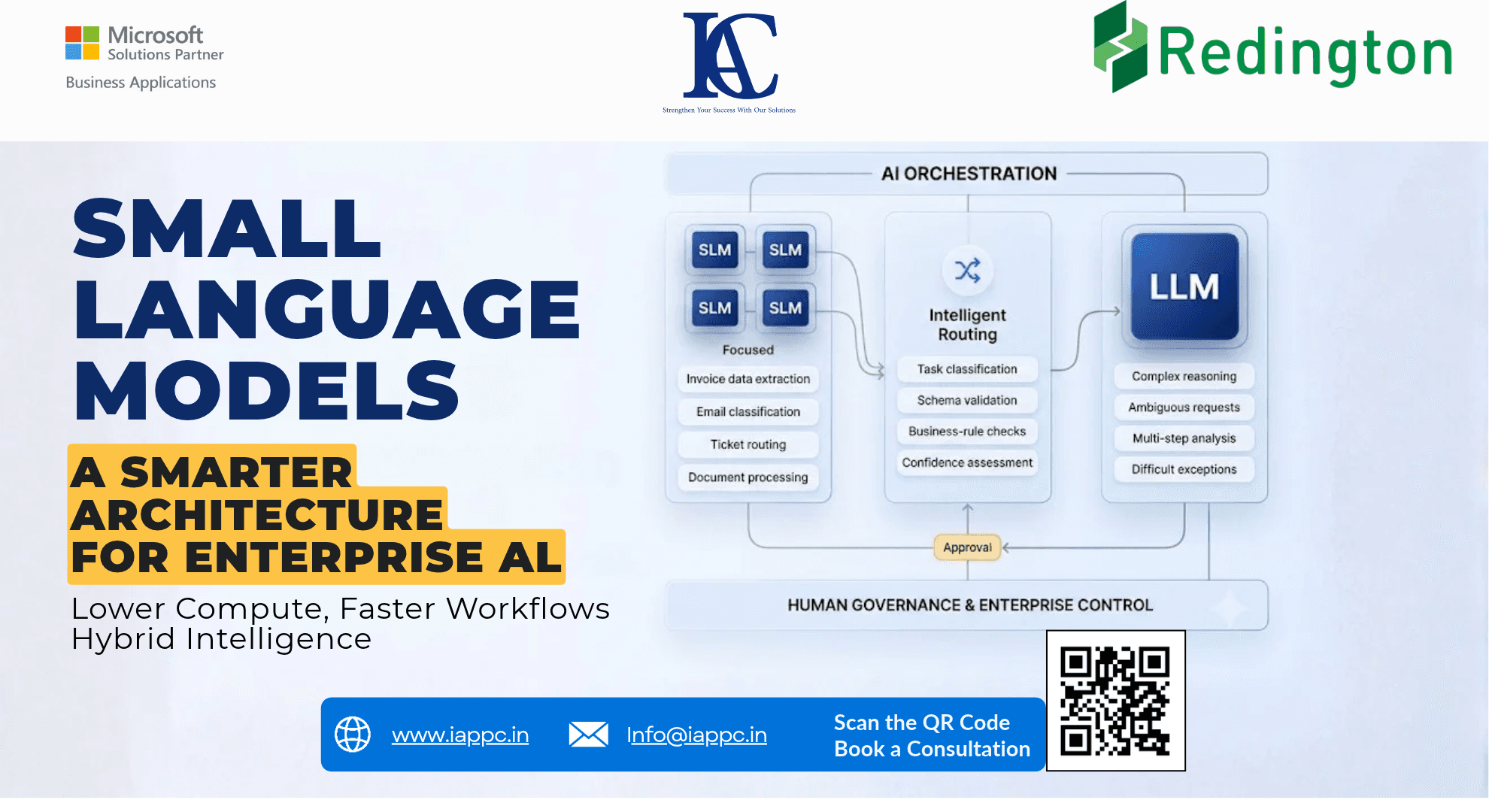
Small language models (SLMs) are compact AI models that run on far less compute than large foundation models. In enterprise agentic AI, they fit narrow, high-volume steps such as classifying a request, extracting invoice fields, or routing a ticket. The strongest production setup is usually hybrid: an SLM handles the routine work, deterministic code validates it, and a larger model or a person takes the hard cases.
Here's what we'll cover: what SLMs are, when they beat a large model, how a hybrid architecture works, what private deployment does and doesn't protect, and how to run a rollout you can measure.
What Are Small Language Models?
An SLM is a language model built to run with much lower compute and memory needs than a large-scale foundation model.
There's no single parameter cutoff. Depending on the provider and the deployment, SLMs range from under a billion parameters to several billion or more. NVIDIA researchers define them by deployment reality instead: a model small enough to run on a consumer device with practical latency for one user. That boundary will move as hardware improves.
Microsoft's Phi-4-mini-instruct is a good example. It has 3.8 billion parameters and targets applications where efficiency, reasoning, and instruction following matter.
Size isn't the point. What matters is whether the model fits a defined workload.
Why enterprises are evaluating SLMs
Three things drive the interest.
Lower inference requirements. Smaller models generally need fewer compute resources than much larger ones. That suits high-volume classification, extraction, and routing.
Deployment flexibility. Depending on the model and your infrastructure, an SLM can run in a private cloud, on-premises, or at the edge. Your architecture team gets more say over where inference happens.
Task-specific tuning. You can adapt an SLM with domain examples, instruction tuning, and structured prompts. That can lift performance on a defined business task, as long as you test it on representative data.
What the research says
NVIDIA Research's 2025 position paper, "Small Language Models Are the Future of Agentic AI," argues that most calls inside an agent are repetitive, narrow, and non-conversational, so SLMs are often enough, and often cheaper. It also argues for heterogeneous systems, where agents call several models of different sizes and keep a large model for open-ended work.
It's a position paper, not a benchmark of your workload. Treat it as a strong reason to test SLMs. We wouldn't call it proof that they'll win in your environment.
Small vs Large Language Models: Choosing the Right Architecture
Base the choice on workload complexity, accuracy needs, latency, operating cost, and deployment constraints.
No cost or latency advantage holds for every model. Results depend on hardware, model size, quantization, context length, request volume, concurrency, and serving setup.
So don't compare token prices alone. Measure the cost per successfully completed business task. A cheap model that fails often and needs rework isn't cheap.
The Hybrid Architecture: SLMs and LLMs Together
You don't have to pick one model. A practical enterprise setup mixes SLMs, larger models, ordinary software, and human approval.
Take a company that processes thousands of vendor emails and purchase documents. A hybrid workflow might run like this.
Step 1: Classify and route
A compact SLM identifies the request type: invoice query, purchase order update, delivery issue, or vendor onboarding. It pulls out the key identifiers and returns a structured response.
Step 2: Extract structured data
A domain-adapted model extracts the invoice number, supplier name, date, tax amount, and purchase order reference. A defined JSON schema checks the output before it goes to another system.
Step 3: Validate with deterministic logic
Application code and your enterprise systems check the result. Does the vendor exist? Does the invoice match the purchase order? Are the required fields there?
The model shouldn't approve financial transactions or change critical records on its own. Keep authorization controls in place.
Step 4: Escalate the hard cases
If the input is ambiguous, validation fails, or confidence is low, the workflow sends the request to a larger model or a human reviewer. Expensive reasoning gets used only when the task needs it.
Measure the escalation rate on real production traffic. Don't assume it in advance. The NVIDIA paper estimates that a large share of calls in three open-source agents could move to specialized SLMs, but those were estimates for those agents, not your workflows.
Private Tenant Deployment and Data Control
For CTOs, CIOs, and security teams, where a model runs matters as much as what it can do.
SLMs often give you more deployment flexibility, because their resource needs are modest. Depending on the license, runtime, and infrastructure, you might host one in:
Private cloud: inference inside your controlled cloud environment.
On-premises: selected workloads on your own servers.
Hybrid environments: sensitive processing near your enterprise systems, with external services for approved tasks.
Edge infrastructure: suitable models close to operational equipment or branch systems.
One warning. A private deployment doesn't make data secure by itself. You'll still need access controls, encryption, network policies, logging, model governance, retention policies, and a secure integration design. Privacy depends on the whole architecture, not on a model's parameter count.
A Practical Roadmap for Enterprise SLM Deployment
A controlled rollout beats picking a model off a leaderboard. It's also the approach we'd recommend.
Pick a clearly defined task. Choose a workflow with measurable inputs and outputs, such as ticket classification, invoice extraction, or document routing.
Set a baseline. Record processing time, error rate, manual intervention, volume, and operating cost today. Without it, you can't prove improvement.
Test candidate models. Use representative, permissioned enterprise data. Compare extraction accuracy, schema validity, response time, throughput, and performance on difficult cases.
Adapt only where needed. Try prompting and retrieval-augmented generation first. Use fine-tuning, such as LoRA, when the use case justifies it. Often a good prompt or retrieval layer is enough, and it's far cheaper.
Add validation and fallbacks. Use schema validation, business-rule checks, confidence thresholds, and human review. Log failures and watch performance as your data and processes change.
Measure production ROI. Compare total deployment and running cost with the business value delivered. Count infrastructure, integration, monitoring, maintenance, and human review.
Where This Applies in Practice
You'll see the workflows above everywhere: invoice and receipt extraction, vendor reconciliation, client query handling, document processing. Innovative TechPlus builds AI products in these areas, including Expense Genius for invoice-to-Excel extraction, DocuMentor for document processing, a Vendor Management Portal with AI invoice processing, and a Query Tracking Tool with an AI assistant for ticket analysis.
Model sizing is a design decision inside work like this. Which model fits depends on the task, the data, and the deployment constraints, and that's the conversation to have before you commit.
Frequently Asked Questions
Can small language models replace large language models in enterprise AI?
Not in every case, no. SLMs suit focused tasks like classification, extraction, and structured routing. LLMs still do better on complex reasoning, ambiguous requests, and broad language work. A hybrid architecture can use both.
Are small language models suitable for agentic AI?
Yes. SLMs can support agentic workflows by interpreting requests, selecting tools, extracting information, and returning structured outputs. Reliable execution still needs orchestration, validation, permissions, and monitoring.
Can SLMs run inside a private enterprise environment?
Some can. They'll run in local, on-premises, or private-cloud setups, though your options depend on model licensing, hardware, inference runtime, and integration requirements.
Does fine-tuning guarantee better enterprise accuracy?
No. It can help on specific tasks, but results depend on training data quality, evaluation method, and workflow complexity. Test against independent validation data before you go to production.
How should enterprises compare SLM and LLM costs?
Compare the total cost per successful task. Include inference, infrastructure, integration, monitoring, retries, human review, and maintenance. Token pricing alone isn't the full cost.
Build Enterprise AI Around the Workload
The next stage of enterprise AI won't depend only on access to bigger models. It'll depend on architecture choices that balance capability, cost, speed, security, and reliability.
SLMs give you another option. They can handle focused tasks efficiently while larger models stay available for work that needs broader reasoning. Start from your actual business processes, not from the biggest model on offer. That's how we approach it.
Innovative TechPlus helps organizations evaluate and build enterprise AI solutions, including workflow automation, custom AI applications, and integrations with existing business systems.
Want to test an SLM on one of your workflows?
Talk to us about an architecture built around your operational requirements.
Sources: Belcak et al., "Small Language Models Are the Future of Agentic AI," NVIDIA Research (arXiv:2506.02153, 2025); Microsoft, Phi-4-mini-instruct model card; Innovative TechPlus product descriptions from iappc.in/ai-products. The product descriptions don't state which models power each product.