Enterprise AI Agents in Production: The 79%-to-15% ROI Gap
79% of enterprises run AI agents in production, but only 15% tie them to P&L outcomes. What Genpact's November 2026 data says about closing the gap
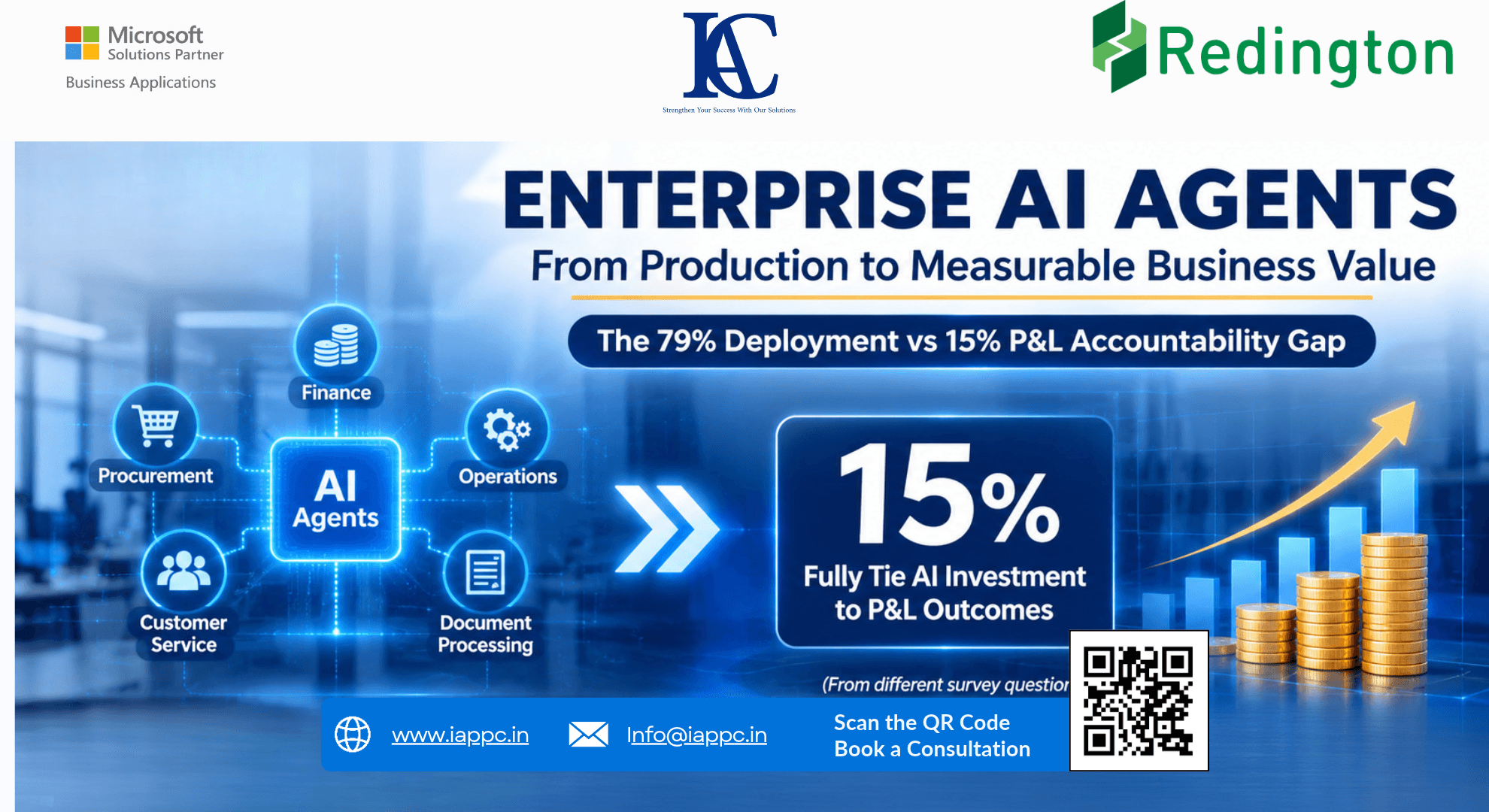
Most enterprises aren't asking whether to try AI agents anymore. They're asking why so few of those agents show up on the income statement.
Genpact's Autonomy in Practice report (PR Newswire / Genpact), released November 12, 2026, surveyed 2,005 executives. 79% said they have agentic AI live in production. Only 15% have fully tied their AI investment to P&L outcomes. The two numbers come from different survey questions, so treat the 64-point gap as a rough measure of the distance between deployment and accountability. It's still a big distance. Genpact also found that only 20% use agents broadly across functions, and some "agents in production" may really be chatbots or copilots. (Note: Genpact sells agentic operations services, and these figures are survey self-reports.)
Why Isolated Pilots Miss the P&L
A lot of early agents shipped as standalone chat tools. They summarize meetings or answer policy questions. Individual employees like them. But they sit outside purchasing, invoicing, inventory, and customer systems, so they save minutes without moving cycle time, working capital, or margin.
Genpact's read is that this is an operating-model problem more than a technology problem. Its answer is what it calls agentic operations: running people and agents as one workforce. Freed-up time only becomes capacity when someone owns where it goes.
Two Signals from the Week of November 10
On November 10, 2026, IBM and Microsoft announced Imagine Enterprise (IBM Newsroom | Microsoft Source), a platform for building, running, and governing AI agents for industry-specific processes. It launches with more than 6,000 prebuilt agents and assets from IBM Consulting, built to connect to a client's existing data and systems.
On November 11, 2026, Leonis Capital published its 2026 AI 100 (36Kr / Leonis Capital). Forty of the 100 companies now serve a single industry, up from 28 last year, as products in law, healthcare, insurance, and finance move from pilots to deployments.
Neither announcement proves that vertical AI fixes the ROI gap. Together they show where vendors and investors are placing bets: agents that know an industry's rules and plug into its systems.
What Separates the Leaders
Genpact calls the top 17% of its AI Maturity Index "AI Leaders." 49% of them fully connect AI value metrics to specific P&L lines. Among everyone else it's 7%. Leaders were also more likely to create roles built for people working alongside agents (51% versus 22%).
Here's the practical version we'd start with:
Pick one high-volume queue. Invoice extraction, PO matching, and approval routing are good candidates because saved hours turn into capacity you can measure.
Put rules around the model. Pair it with explicit business rules and a human checkpoint for exceptions, so a bad output gets caught before it hits a ledger.
Count finished tasks, not prompts. Track cycle time, error rate, and cost per completed transaction, and give each number a named owner.
Frequently Asked Questions
Why do 79% of enterprises run AI agents while only 15% tie them to the P&L?
Genpact's research points to operating model, not technology. Many deployments sit outside core workflows, and no one owns where the saved time goes.
Are vertical AI platforms beating generic AI tools?
The evidence is early. Leonis's list shows more single-industry companies than last year, and IBM and Microsoft are building industry-specific agent platforms. Neither shows that vertical tools deliver better P&L results yet.
Where should an enterprise start?
With one measurable workflow, such as document extraction or approval routing. Benchmark cost and time per completed task before scaling.