Dynamics 365 Business Central Implementation: A Practical Guide for Growing Indian Businesses
Plan your Dynamics 365 Business Central implementation in India: license costs, realistic budgets, timelines, GST limits and a 4-phase rollout plan
A Dynamics 365 Business Central implementation for an Indian company in the ₹20 crore to ₹150 crore bracket usually runs from about 8 weeks to 6 months. Budgets in public guides range from a few lakh rupees to over a crore, and that spread is real. Your cost depends on users, entities, integrations, manufacturing and how much you customise. We'll show you where published figures disagree, what Business Central does and doesn't cover for GST, and how to test a partner's quote before you sign.
Why do growing companies outgrow Tally and QuickBooks?
At this size, the old tools strain in predictable places. Stock counts differ between warehouses. Your controller spends days matching GSTR-2B and Form 26AS outside the books. Customer service can't see an order across locations. Sound familiar?
Compliance adds pressure. E-invoicing has applied to any business with aggregate turnover above ₹5 crore since 1 August 2023. At ₹10 crore or more, the Invoice Registration Portal also rejects documents older than 30 days. If you're in this bracket, both rules apply to you.
Tier-1 systems such as SAP S/4HANA and Oracle Cloud ERP are built for larger IT teams and longer projects. Entry-level packages tend to run out of room on dimensions, manufacturing and multi-entity reporting. Business Central sits in the middle. Don't treat it as a software swap, though. It's an operational change, and most of the risk lives in your data, your processes and your people, and the licence is the small part.
What makes Business Central different from legacy ERP?
One database. A warehouse receipt, a sales invoice and a recurring billing run all post to the same general ledger. Finance and operations work from one continuous record, with no batch sync between modules.
Dimensions, not account-code sprawl. Older systems push you to bake department, product line and region into account numbers like 4000-01-100-200. Business Central keeps the base account clean (4000, Sales Revenue) and attaches dimension values to each entry. You get two global dimensions and up to eight shortcut dimensions, and the first two shortcut slots are the global ones. Choose them with care. They're the filters your team will use every day.
Microsoft 365 connections. Users can edit lists in Excel and work with documents from Outlook. Sign-in uses Microsoft Entra ID.
Copilot and agents, with a human in charge. Bank reconciliation starts with rule-based automatic matching. Copilot then proposes matches for lines the rules missed and suggests G/L accounts, and nothing is saved until you review it. That Copilot feature's online-only. The Payables Agent runs on its own schedule, reads invoices from a monitored inbox, extracts data with Azure Document Intelligence and creates draft purchase invoices. Microsoft says it'll never post invoices or changes financial data without human approval. Treat agents as preparation tools. For the control side, read our guide to [INTERNAL LINK: /ai-agent-governance-india-human-oversight "AI agent governance in India"].
Regular updates. The cloud version gets two major updates a year, in April and October, plus monthly minor updates. Version 29 is due in October 2026. Someone still has to test your extensions against each release, and it won't be Microsoft.
Which modules do growing companies actually use?
Financial management. General ledger, payables, receivables, bank reconciliation, multi-currency with exchange-rate adjustment, fixed assets and consolidation. Eliminations in consolidation are a manual step, though Microsoft provides a report that previews their effect. If you run many entities with heavy intercompany traffic, ask your partner how they'll handle it.
Supply chain and inventory. Multiple locations, order promising with available-to-promise and capable-to-promise logic, replenishment suggestions from lead times and open orders, and lot and serial tracking.
Sales and purchasing. Customer-group and volume-break pricing, quote-to-order conversion, and warehouse documents for picking and shipping. How automatic picking is depends on your warehouse set-up.
Manufacturing and assembly. Multi-level bills of materials, routings, production orders and capacity planning. These need the Premium licence. Essentials doesn't include them.
What does the India localisation cover?
Microsoft maintains an India version, and its documentation covers GST, TDS (including section 194Q), TCS, fixed assets, gate entry, subcontracting and a voucher interface. For e-invoicing, Microsoft's documentation describes generating the e-invoice JSON file and importing the signed response. Some partner sources describe direct IRP integration, so ask exactly how it works in the version you'll run, and whether it needs an add-on or a GST suvidha provider.
Where does Business Central stop?
Reconciliation against GSTR-2B and Form 26AS isn't part of the standard localisation, according to a reconciliation vendor's write-up for version 23 and later. AppSource add-ons exist for parts of it, including a 26AS TDS reconciliation app. Confirm the position for your version, and don't skip budgeting for an add-on or an external tool if your team relies on input-tax-credit matching.
What does a Business Central implementation cost?
You pay for licences and for implementation. Keep them in separate lines.
Licences. Microsoft's US list prices, billed annually, rose in November 2025 to about $80 per user per month for Essentials, $110 for Premium and $8 for Team Members. Older guides still show $70 and $100, so don't trust a stale page. One Indian partner's guide puts Essentials at ₹5,500 to ₹6,500 and Team Members at ₹600 to ₹800, but that guide predates the increase. Straight conversion at about ₹96 per dollar, the mid-2026 rate, gives roughly ₹7,700, ₹10,600 and ₹770. So 25 Essentials users could cost around ₹17 to ₹23 lakh a year. Ask whether a quote includes GST. Software subscriptions are usually taxed at 18%, and it's easy to miss.
Implementation. Here the sources disagree sharply, and it's worth knowing why. Indian partner guides publish much lower figures than guides written for US and UK buyers. Both are indicative. Neither is a quote.
Don't average these numbers. Use the gap as a prompt to compare scope line by line: users, entities, integrations, migration volume, training and whether GST add-ons are in. A cheap quote that leaves out integrations or reconciliation tools isn't cheap. It's incomplete.
What moves cost most is data migration from Tally or spreadsheets, integrations with e-commerce, CRM, banks and logistics, custom code, and training. Migration is often the most under-quoted item.
How much should you customize?
Less than you'd think. Only about one company in ten runs ERP with no customization, according to a Panorama Consulting survey cited by Aptean, so some change is normal. The cost shows up later, in testing every update against your changes. We can't point to a reliable percentage for how often requested custom code duplicates standard features, so be wary if a partner quotes one.
Our rule of thumb is to configure first, then use extensions only for what's truly specific to your business. Put one question to every requirement: does this give us an edge, or is it just how the old system did it?
What does a four-phase rollout look like?
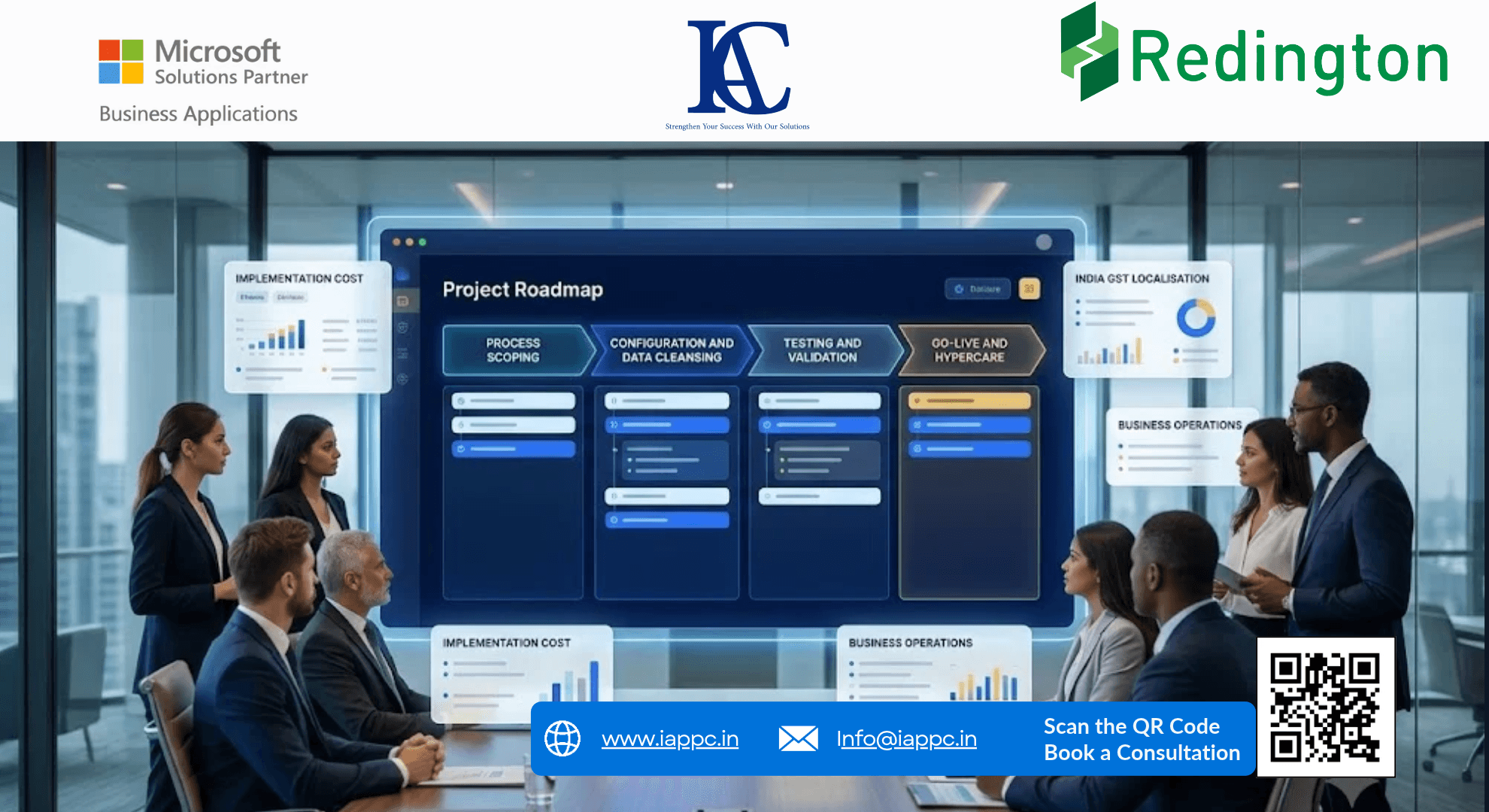
Here's the four-phase framework Innovative TechPlus (ITP) uses. The week ranges are illustrative for a mid-market scope, so scale them to your data readiness and integrations.
Process scoping and as-is mapping (weeks 1 to 3). Document how work really flows, plus the rules that can't bend: GST posting logic, TDS sections, approvals. Set KPI baselines. Then audit your master data before you fix the migration scope.
Configuration and data cleansing (weeks 4 to 8). Set up dimensions, posting groups, approval workflows and GST registration mapping for each state and GSTIN. Clean and de-duplicate legacy masters. Map every legal entity and location to its e-invoicing status, because that's where surprises hide.
Testing and conference room pilots (weeks 9 to 12). Your users run order-to-cash, procure-to-pay and GST invoicing in a sandbox. Test the ugly cases. An invalid GSTIN. A missing HSN code. A portal timeout.
Cutover, go-live and hypercare (weeks 13 to 16). Migrate opening balances, go live over a weekend and keep consultants close for 30 days. Pick the date with your GST filing calendar in mind. You don't want your first close to be your first filing too.
Frequently asked questions
What's the difference between Business Central cloud and on-premises?
Cloud is Microsoft-hosted, with two major updates a year and monthly minor ones. On-premises means you run servers, backups and upgrades yourself, and each version has a fixed support window.
Can Business Central connect to our e-commerce and CRM systems?
Yes. It has connectors for Shopify and Dataverse, works with Dynamics 365 Sales, and offers REST and OData web services for other systems. Integrations are a separate budget line and a common source of scope growth.
How does Business Central handle Indian tax compliance?
Microsoft's India version covers GST, TDS and TCS. Confirm how e-invoicing reaches the government portal in your version. GSTR-2B and Form 26AS reconciliation isn't part of the standard localisation.
Are AI agents in Business Central autonomous?
The Payables Agent works on its own schedule, but it only creates drafts. Microsoft says it never posts invoices or changes financial data without human approval. Keep your approval rights and permissions tight anyway. You'll thank yourself later.
Do we need Premium or Essentials?
If you run production orders or service management, you'll need Premium. Trading, distribution, and most services firms do fine on Essentials. Licensing guides also say full users in one tenant generally can't be split across both, so confirm before you count seats.
What to do next
Before you talk to partners, write down your entities, GSTINs, locations, integrations, reconciliation needs and must-keep processes. Then ask for fixed-scope quotes with the assumptions spelled out, including migration volumes, integrations, GST add-ons, and training. If a partner won't commit to assumptions, that's your answer.
Innovative TechPlus offers an architecture consultation covering scope, licensing and a fixed-scope implementation plan.