Custom Software vs. Off-the-Shelf Software in India: How to Choose for Your Business Operations
Build or buy? Compare custom vs. off-the-shelf software in India with a 36-month TCO model, GST factors and a five-point decision framework.
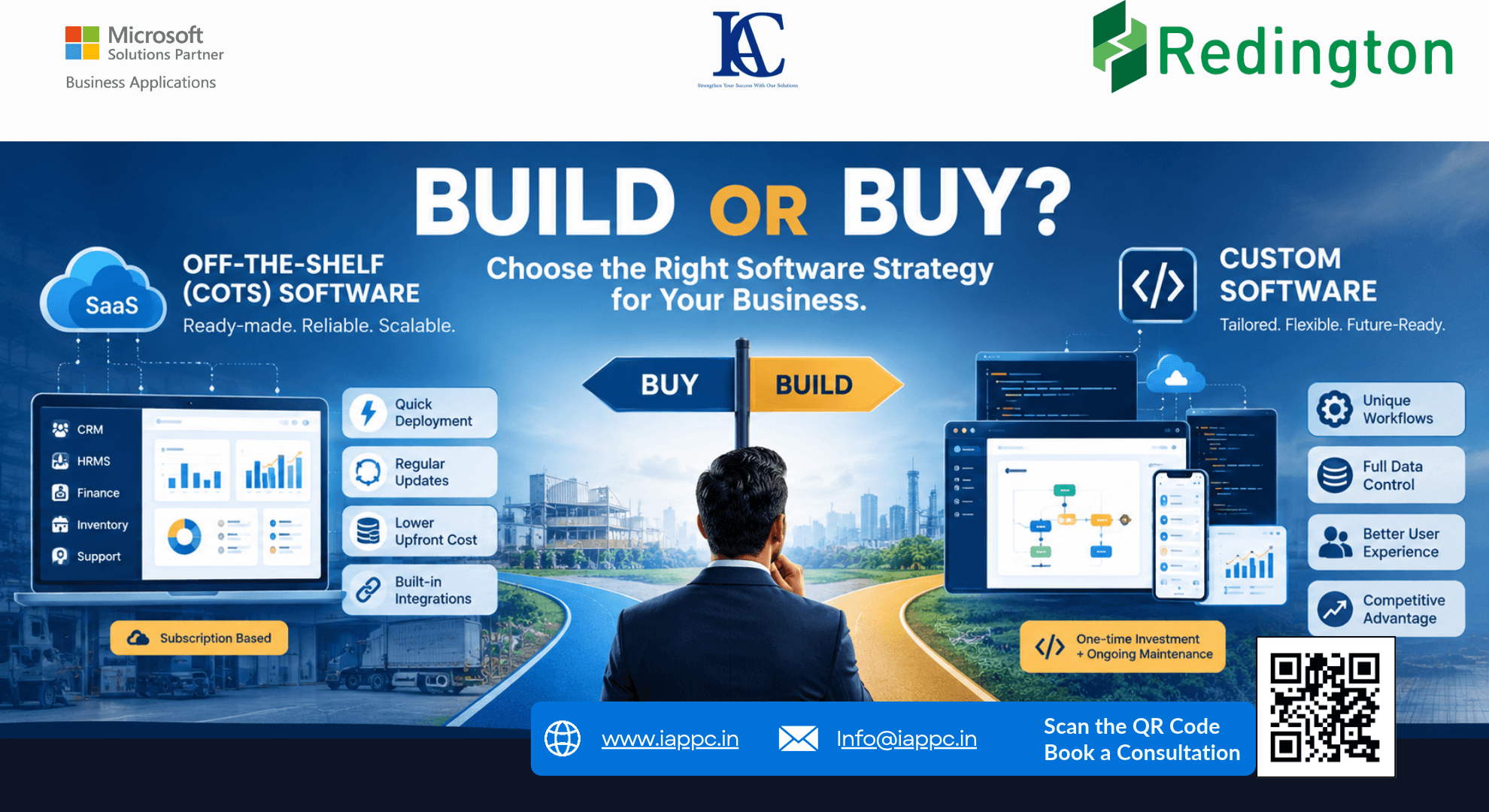
Quick answer: Buy off-the-shelf software for standard work like accounting, payroll and GST filing. Build custom software for the few workflows that set your business apart, such as dealer ordering or production planning. Most mid-sized Indian companies end up with both: a bought ERP at the core and custom applications around it. In the illustrative 50-user model below, a focused custom application costs ₹35-60 lakh over 36 months, against ₹60-77 lakh for configured SaaS. That gap shrinks fast when your needs are standard or your user count is small, so here's how to test your own case.
Build vs. Buy: A Decision Growing Indian Businesses Can't Postpone
Picture a manufacturer running across three states. Finance handles GST transactions. Production tracks bills of materials (BOMs). Sales takes distributor orders, and the warehouse juggles stock across several locations.
Spreadsheets and standard apps cope at first. Then volumes climb, data gets re-keyed between systems, and somebody's inbox becomes the approval workflow.
Sooner or later leadership asks the question: do we buy an existing commercial product, or build software around how we actually operate? That's the build vs. buy decision, and it usually gets framed as two camps:
Buy: faster rollout, standard features, no new application to maintain.
Build: workflows shaped to your business, tighter control over the roadmap, a possible edge over competitors.
The real answer rarely sits at either extreme. With cloud infrastructure, mature APIs, low-code platforms and modern frameworks, many Indian enterprises now pair an established ERP with purpose-built applications for the processes that matter most. The trick is deciding which processes to standardise and which deserve custom engineering.
Here's what we'll cover: a 36-month Total Cost of Ownership (TCO) model comparing custom software with off-the-shelf SaaS, India-specific factors like GST and data protection, and a five-point framework you can apply to your own situation.
1. What Is Off-the-Shelf Software (COTS)?
Commercial Off-The-Shelf (COTS) software is a ready-made product built for a broad customer base. You configure and deploy it; you don't develop it. Common examples in Indian businesses include accounting packages, CRM platforms, HRMS and payroll tools, inventory and warehouse systems, helpdesk software and ERP.
Where off-the-shelf software wins
Speed. Core modules already exist. You configure them, migrate your data and go live in a fraction of the time a new build takes.
Vendor-managed updates. Feature releases, security patches and platform upgrades arrive without a project on your side. For Indian users, that can include GST changes, e-invoicing support and reporting improvements.
Lower upfront spend. You pay implementation fees and a recurring subscription instead of funding a full development project, which keeps technology costs predictable.
Ready-made integrations. Most established products ship with APIs and connectors for payment gateways, accounting tools, Microsoft 365 and other common systems.
Where it hurts
The 80/20 customisation gap. A packaged product can cover most standard needs and still fall over on the one process that matters. Take an Indian steel distributor that needs dealer-specific pricing, weight-based order calculations, material-grade tracking, multi-warehouse dispatch and credit-limit approvals. If the software can't handle that, the company pays for heavy customisation, bolts on third-party tools or falls back on manual workarounds. The result is a patchwork.
Per-user licensing that compounds. Many SaaS tools charge by user, tier or transaction volume. Growing from 25 to 100 employees can multiply your bill. Don't judge the cost by the first-year quote; look at three to five years.
Workflow rigidity. Packaged software is built for the average customer, so your team may end up bending to its screens, fields and approval steps. Unneeded clicks add up fast.
Vendor dependency. Pricing, roadmap, feature availability and integration support sit with the vendor. Before you sign, check data portability, API access, renewal terms and the exit process.
2. What Is Custom Software Development?
Custom software is built around your processes, your requirements and your technology architecture. Rather than adapting the business to an application, developers design the application to fit the business.
Typical examples in Indian enterprises:
Distributor and dealer order portals
Manufacturing and production tracking apps
Vendor onboarding and procurement portals
Field sales and service management apps
NBFC customer onboarding and internal workflow tools
Automated reporting platforms
AI-assisted document processing and approvals
Where custom software wins
It supports what makes you different. Take a distribution company whose sales reps use a mobile app to capture orders, check live stock, validate credit limits and push approved orders straight into the ERP. That workflow matches its sales model. A generic product wouldn't.
More control over architecture and data. You decide the database design, access permissions and feature priorities. But ownership won't take care of itself, so write it into the contract: source code, intellectual property rights, documentation, repository access and deployment credentials. Keep in mind that a custom app may still rely on separately licensed cloud services, databases and third-party APIs.
Better user experience. A warehouse operator needs barcode scanning, stock movements and dispatch confirmation. A director needs dashboards and approvals. A purpose-built app can give each exactly that and nothing else.
Flexibility as you grow. New distribution channel, new product line, new business unit? You priorities the changes yourself instead of waiting on a vendor's roadmap.
Costs and risks people underestimate
Higher upfront investment. Business analysis, architecture, UI/UX design, development, integration, testing and deployment all cost money, and the total swings widely with complexity and the number of connected systems.
Longer timelines. A focused business application can take several months from discovery to production. Complex integrations, many user roles, strict security requirements or enterprise-scale volumes push that out considerably.
Maintenance never stops. You'll need budget and people for cloud hosting, monitoring, security updates, bug fixes, performance tuning, third-party API changes, database upkeep, and new features. A custom application isn't a one-time purchase. It's a product you now own.
3. Custom Software vs. Off-the-Shelf Software: 36-Month TCO Comparison
Here's a common mistake: putting a one-off development quote next to a single year of SaaS fees. It doesn't tell you much. A fairer test is total cost of ownership over 36 months.
3. Custom Software vs. Off-the-Shelf Software: 36-Month TCO Comparison
Here's a common mistake: putting a one-off development quote next to a single year of SaaS fees. It doesn't tell you much. A fairer test is total cost of ownership over 36 months.
The illustrative scenario
An Indian mid-market company with 50 active users, several departments, a core accounting or ERP system it will keep either way, specialised operational workflows, and a need for integrations and reporting. The question is how to cover one specialised workflow, such as dealer ordering: configure an off-the-shelf SaaS application, or build a focused custom one. We assume the SaaS application costs a blended ₹7,000 per user per month.
All figures are illustrative planning assumptions, not quoted Indian market averages or vendor prices. Amounts exclude applicable GST, internal employee costs, financing costs, major scope changes and additional third-party licence charges. The custom option is a focused business application. It isn't a full replacement for an enterprise ERP.
How the subscription line is calculated
₹7,000 × 50 users × 36 months = ₹1,26,00,000, or ₹126 lakh (₹1.26 crore) in workflow-application licences alone. Add 10 more users and the same three years cost another ₹25.2 lakh. The license rate drives this table more than any other line: at ₹2,500 per user, the SaaS total would be ₹60-77 lakh and the custom option's edge would shrink sharply, so test your own vendor quote.
The ERP license sits outside this table
If your core system is Microsoft Dynamics 365 Business Central, you pay for those licences whichever route you choose, so they don't change the build-vs-buy gap, and they sit on top of the workflow-application licences above. They do belong in your overall budget. Microsoft's US list price is $80 per user per month for Essentials and $110 for Premium on annual billing, after the November 2025 increase, and Team Member seats cost $8. As a ceiling, 50 Essentials users over 36 months come to $144,000, roughly ₹1.2 crore at an assumed ₹85 to the dollar. Most companies need fewer full users than that, and India pricing can differ, so get a partner quote before you plan around the number.
4. When to Build vs. Buy Software: A Five-Point Decision Framework
Run your project through these five tests before you commit either way.
Test 1: Does it differentiate you?
Ask whether the software supports something that makes your business different. A manufacturer with proprietary production-planning logic may justify a custom build. A distributor with unusual dealer-order workflows may justify a custom sales app. A company that needs standard financial accounting has no reason to reinvent it.
Verdict: build when the technology feeds a real competitive advantage; buy when the need is standard.
Test 2: Can the process follow an industry standard?
General ledger, accounts payable and receivable, GST calculations, standard procurement, employee records and payroll all have well-worn processes. Established products serve them well, and there's little to gain from rebuilding them. Production sequencing, one-off order validation or dealer incentive calculations are different, and those may justify custom work.
Verdict: standardise the routine and customise only where the process is truly yours.
Test 3: Does a mature product already exist?
Before you build anything, check what's on the market. Does a product cover the functionality you need, plus integrations, access controls, scalability, Indian business features and dependable vendor support?
A useful rule of thumb: consider buying when a mature product meets roughly 80-85% of your essential requirements without expensive workarounds. Look at the remaining 15-20% one item at a time. A gap shouldn't automatically become a development project.
Verdict: if a good product already solves the problem, buy it.
Test 4: How fast do you need to move?
Say a distributor is opening a new sales channel next quarter. A nine-month build won't make it. Configuring an established platform, or running a temporary standard solution while a custom piece is built, is often the better call.
Verdict: when deployment speed is critical and suitable functionality exists, buy first.
Test 5: Can you maintain what you build?
Custom software needs a long-term owner. Have you got experienced developers or a reliable implementation partner? Written documentation? Backup and security procedures, application monitoring, a maintenance agreement, and clear ownership of source code and IP? Without them, even a well-built app becomes a liability you didn't plan for.
Verdict: build only when you can govern and maintain it for years.
5. The Hybrid Approach: Composable ERP Architecture
For many growing Indian enterprises the answer isn't pure custom or pure off-the-shelf. It's a hybrid: a standard ERP as the system of record, with custom applications around the specialised operations.
Step 1: Buy the core. Use an established ERP for standard operations. Microsoft Dynamics 365 Business Central, for example, covers financial management, the general ledger, sales and purchasing, inventory, multi-company operations, GST-related processes and financial reporting. Its India localisation includes GST functionality, and Microsoft's documentation describes support for Indian e-invoice workflows. Validate the exact localisation features, extensions and integration needs before you implement.
Step 2: Build around it. Develop custom applications where standard ERP functionality falls short:
Sales and distributor portal. Field teams and distributors submit orders, check availability, review pricing and track order status.
Manufacturing workflow app. Specialised production tracking, material consumption, quality checks and shop-floor operations.
Vendor management portal. Supplier registration, document collection, approvals and performance tracking.
Customer self-service portal. Quotations, orders, invoices and service requests in one place.
Step 3: Connect through APIs. Link the custom apps to the ERP through documented APIs and suitable integration services. The ERP keeps core financial and operational records, the custom apps run specialised workflows, BI tools turn operational data into management insight, and AI handles selected tasks with human oversight.
Why it works. You avoid rebuilding standard enterprise functionality, and you keep room to develop what's unique to you. For manufacturers, logistics firms, distributors, and financial services companies, that modular setup is a practical base that can evolve as the business does.
6. India-Specific Factors to Check Before You Decide
Comparing features and subscription prices isn't enough here. Check how each option handles Indian operational and regulatory requirements.
GST and e-invoicing. Multiple GST registrations and GSTIN management; CGST, SGST and IGST calculations; HSN and SAC classification; GST reporting and reconciliation; e-invoice generation and IRN workflows, where applicable; e-way bill integration, where applicable.
Accounting and finance. TDS and TCS workflows, bank reconciliation, multi-branch accounting, cost centres and financial dimensions, vendor payments and multi-company consolidation.
Indian business integrations. Depending on your model: UPI and payment gateways, banking systems, e-commerce platforms, logistics and transport providers, CRM and field-sales apps, WhatsApp-based customer engagement, and your existing ERP or accounting system.
Data protection and security. If you handle personal data, look at the Digital Personal Data Protection Act, 2023 and the notified DPDP Rules, 2025. Your architecture should account for data collection, notices, access control, retention, security safeguards and data lifecycle management, in line with the phased enforcement timeline. Don't leave security and data protection until after launch; raise them at the architecture stage.
7. How to Choose a Software Development Partner in India
Whether you're buying enterprise software or commissioning a custom build, your implementation partner shapes the outcome. Ask five questions:
Do they understand your business? Your industry, your workflows, your operational headaches.
Can they explain the architecture? APIs, integrations, scalability and security, in plain terms.
Have they integrated with systems like yours? ERP, CRM, finance and reporting tools.
What happens after go-live? Documentation, maintenance, updates and who is responsible for what.
How will you measure success? Processing time, order accuracy, reporting speed, manual effort saved.
What you want is a partner who gets operations, not just a team that ships code.
Frequently Asked Questions
What is the difference between custom software and off-the-shelf software?
Custom software is built for one organisation's requirements. Off-the-shelf software is a pre-built product that's designed for many customers. Custom gives you workflow flexibility. Packaged software generally deploys faster, and you won't have to build the standard functionality yourself.
How much does custom application development cost in India?
It depends on complexity, integrations, user requirements, security, infrastructure and long-term support. In the illustrative 50-user scenario above, a focused custom application has an assumed initial development budget of ₹25-40 lakh, plus infrastructure, support and maintenance over 36 months. A smaller application may need a different budget, and a large enterprise platform can cost far more. Ask for a scope-based estimate instead of relying on a generic per-application price.
When should a business build custom software instead of buying SaaS?
Consider it when the application supports specialised workflows, gives you a competitive advantage, fixes limitations in existing products, or offers better economics at scale. Standard activities like accounting and routine HR usually don't need custom code; established products serve them better.
Is custom software more secure than off-the-shelf software?
Not automatically. Security depends on architecture, development practices, identity management, infrastructure, monitoring, vulnerability management, and ongoing maintenance. A well-run commercial product can be more secure than a neglected custom one.
How can Indian businesses avoid SaaS vendor lock-in?
Review the contract and the technical terms for complete data export, documented APIs, data ownership, backup and recovery, renewal conditions, termination procedures, and migration assistance. Work out your exit strategy before you sign a long-term agreement, because it's far harder to negotiate later.
Can custom applications integrate with Microsoft Dynamics 365 Business Central?
Yes. Custom apps can connect to Business Central through supported APIs, so the ERP holds standard records while specialised apps handle sales, distributors, vendors, manufacturing and customer engagement. Which method fits depends on your requirements and the APIs and extensions available.
What is composable ERP architecture?
It's an approach where a central enterprise platform is combined with modular applications and services. Instead of forcing every process into one large system, you integrate specialised applications around an established ERP. That supports flexibility, integration and gradual expansion.
Conclusion: Build What Differentiates You, Buy What Already Works
Don't settle build vs. buy on technology preference or the sticker price, because neither tells you what you'll pay in year three. Settle it on strategy, operations, integration complexity and 36-month total cost.
For many Indian enterprises, standard finance, accounting and core inventory belong on an established platform. Specialised sales processes, customer experiences, manufacturing workflows and automation may deserve custom engineering, and that's where the budget should go. A hybrid architecture lets you do both. You don't need more software; you need the right software, built around the way you work.
Evaluate Your Build-vs-Buy Decision with Innovative TechPlus
We help businesses evaluate and implement technology across Microsoft Dynamics 365 Business Central, custom application development, AI and business automation. Whether you're modernising an ERP environment, building a specialised application or connecting disconnected systems, the right architecture starts with understanding how you operate.
Talk to our team: https://iappc.in/ | Info@iappc.in
Innovative TechPlus