Business Central 2026 Release Wave 2: What Changes for Finance Teams
See what Business Central 2026 release wave 2 changes in finance: multi-excise duty, self-billing, withholding tax. Read the guide and plan your tests.
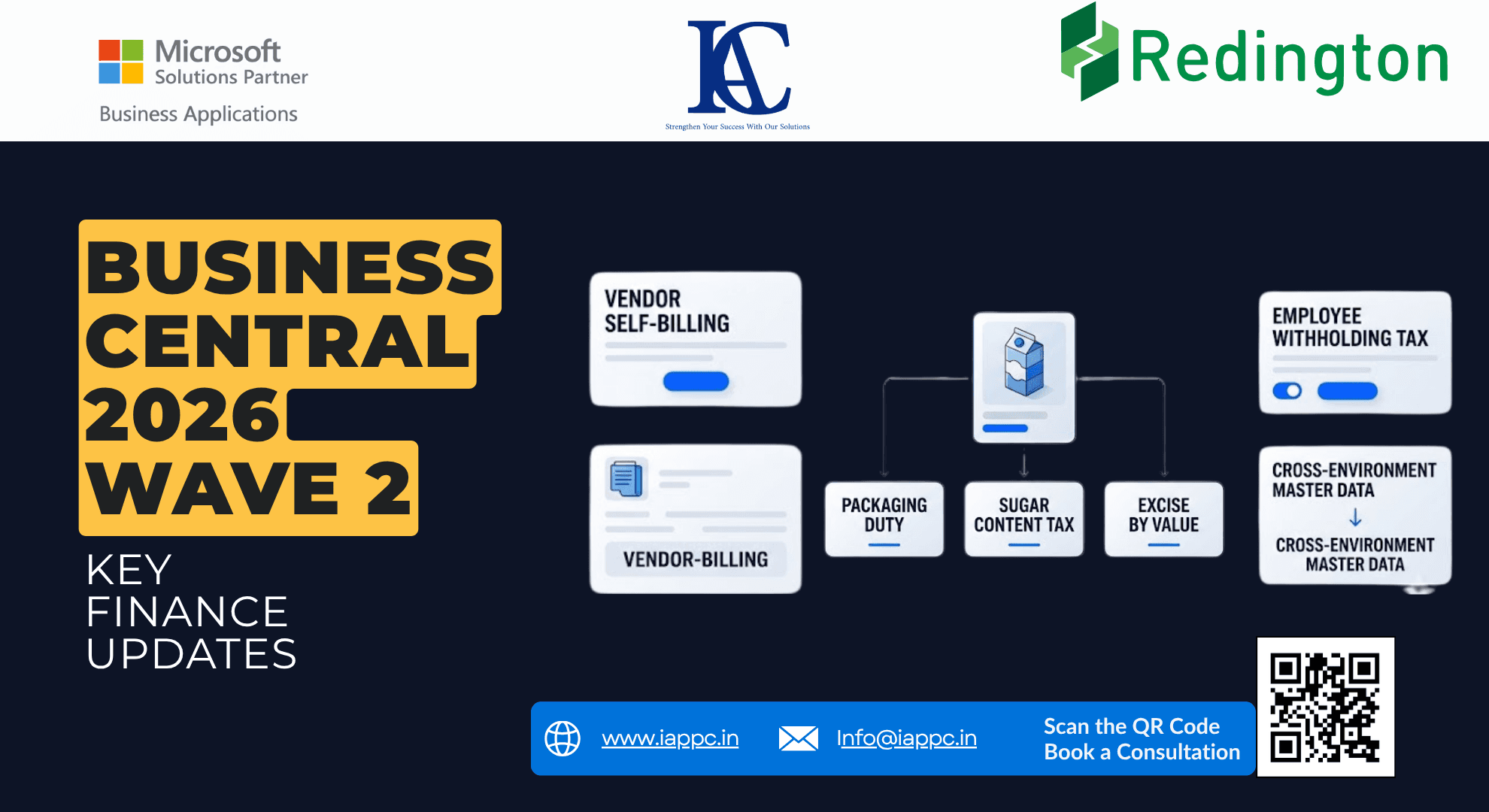
Picture selling one bottle of sweetened drink. You owe a plastic packaging duty and a sugar content tax on it, the bottle sits in a bonded warehouse, and the supplier who made it needs a self-billing invoice in its own number range. Until now, Business Central couldn't hold all of that cleanly, and you probably know it. The Business Central 2026 release wave 2 finance updates are built for exactly this kind of mess.
This guide walks through the four areas that change: excise duty, vendor self-billing with cross-environment master data, employee withholding tax, and country localizations. For each one, I'll show how it works and what you'll want to test first.
A note on sources: this guide is based on a lesson summary of the wave 2 finance plan. Check feature names and availability dates against Microsoft's official release plan before you commit to a rollout.
Multiple excise duties per item
Before wave 2, the item card had one excise fast tab. That meant one duty per item. Real products don't work that way, and finance teams have felt it. A beverage can carry a packaging duty for the plastic and a health tax for the sugar, and a single field can't hold both.
Business Central now replaces the fast tab with an Excise Taxes page. Open it from the Related menu on any item card and attach every duty the item owes. Existing excise setups migrate automatically, so you won't re-enter a thing. [INTERNAL LINK: /guides/business-central-item-card "Business Central item card setup"]
Three calculation models
The wave also widens how a duty gets calculated.
To see how a hybrid duty adds up, take an illustrative shipment of 1,000 liters with a wholesale value of $2,000. The specific part is $100 (1,000 liters at $0.10). The ad valorem part is $100 (5% of $2,000). The total duty is $200. These numbers are made up for the example, so run your own through a sandbox.
Bonded locations and transfers
Two more changes matter if you hold stock under customs control.
Bonded locations. Mark a warehouse location as Bonded. Business Central then skips excise on inbound receipts and stock there, and calculates duty only when goods are formally released.
Transfer entries. Excise permission rules now cover inventory transfers. Duty tracking stays intact when you move stock between locations, not only on sales, purchases and manufacturing.
Vendor self-billing and Peppol
Self-billing is an arrangement where the buyer prepares the purchase invoice for the seller once goods or services arrive. In earlier releases, Business Central used one global number series for all self-billing documents. If you've got several vendor groups, you've likely hit numbering conflicts.
With wave 2, each self-billing vendor can have its own number series. If a vendor has none, Business Central falls back to the default series in Purchases & Payables Setup, so you can move vendors over one at a time.
Self-billing also joins the E-Documents framework. A self-billing invoice can now be generated and transmitted in the Peppol format natively. [INTERNAL LINK: /guides/business-central-e-documents "Business Central E-Documents guide"]
Cross-environment master data management
If you run separate environments per country or brand inside one tenant, you've probably synced master data by hand or with custom integrations. Wave 2 adds Cross-Environment Master Data Management. Subsidiary environments pull data such as the chart of accounts, customers and vendors from a headquarters environment.
The technical details are short, and your IT team will ask about them:
It uses standard OData web services.
Authentication runs through Microsoft Entra ID.
HQ is the single read-only source of truth.
HQ administrators grant explicit read permission to each registered Entra ID application, so subsidiaries sync only authorized tables.
If you plan to use it, I'd talk to your Entra ID administrator early. App registration and permissions are the likeliest source of delay.
Withholding tax on employee payments
Withholding tax logic has traditionally covered vendor payments. Many jurisdictions also require withholding on employee payments, such as expense reimbursements or per diems above the statutory tax-free limit.
Wave 2 doesn't build a new engine. It extends the withholding tax engine to Employee records, alongside Vendor records, in general journals and expense management. You can configure:
Entity type: set a withholding tax business posting group to Vendor or Employee.
Calculation approach: gross or net, using simple or compound formulas.
Thresholds: limits per period or per expense category, so withholding applies only once an employee's total allowance passes the legal tax-free amount.
Localization updates by country
Spain: Veri*Factu support for mandatory electronic invoice reporting, out of the box or through AppSource.
France: general availability of regulatory e-invoicing features.
Germany: updated Intrastat reporting rules and audit file export for EUBP.
Switzerland: fully structured address formatting for Swiss QR-bill invoicing.
Austria and Iceland: standard SAF-T export in the base localizations.
How to test wave 2 safely
Start with whatever hurts most today. And test in a sandbox, not in live data.
Pull last month's real transactions for the area you're testing.
Run them through the new setup.
Compare the output to what your team calculates by hand.
Roll out only when the numbers match.
For excise, begin with items that already carry more than one duty. For self-billing, begin with the vendor group whose invoice numbers collide most often.
FAQ
Can one item have more than one excise duty in Business Central?
Yes. Wave 2 adds an Excise Taxes page, opened from the Related menu on the item card, where you can attach multiple duties to one item. Your existing setups migrate on their own, so there's nothing to redo.
What is a hybrid excise duty?
A hybrid duty adds a unit-based amount to an ad valorem percentage. It's one duty with two parts. The source's example is $0.10 per liter plus 5% of wholesale value.
How does Business Central treat bonded warehouses?
You mark a location as Bonded, and that's it. Excise is skipped on inbound receipts and stock there and calculated when goods are released from the bonded location.
Does self-billing work with Peppol?
Yes. Self-billing is now part of the E-Documents framework, so you can generate and send those invoices in Peppol format. No extra tool.
Can Business Central withhold tax on employee expenses?
Yes. The withholding tax engine now covers Employee records, and you've got the same options as for vendors: gross or net calculation, simple or compound formulas, and thresholds per period or expense category.
Conclusion
The Business Central 2026 release wave 2 finance updates remove workarounds you've probably lived with for years. One item can carry many excise duties, each vendor can have its own self-billing series, subsidiaries can pull master data from HQ, and employee payments can be subject to withholding tax. Country updates cover Spain, France, Germany, Switzerland, Austria, and Iceland.
Pick the feature that matches your biggest headache. Test it in a sandbox with last month's data, and check it against Microsoft's release plan. If you'd like help planning that test,
contact your Business Central partner or consultant.